
Ladakh, literally, ‘Land of High Passes’, is the huge, sparsely populated area found in the very north of India. It is a land of remarkable paradoxes: a barren desert through which flows one of the world’s great rivers, the Indus; it is one of the most remote places on earth, which historically was also a major trading post.
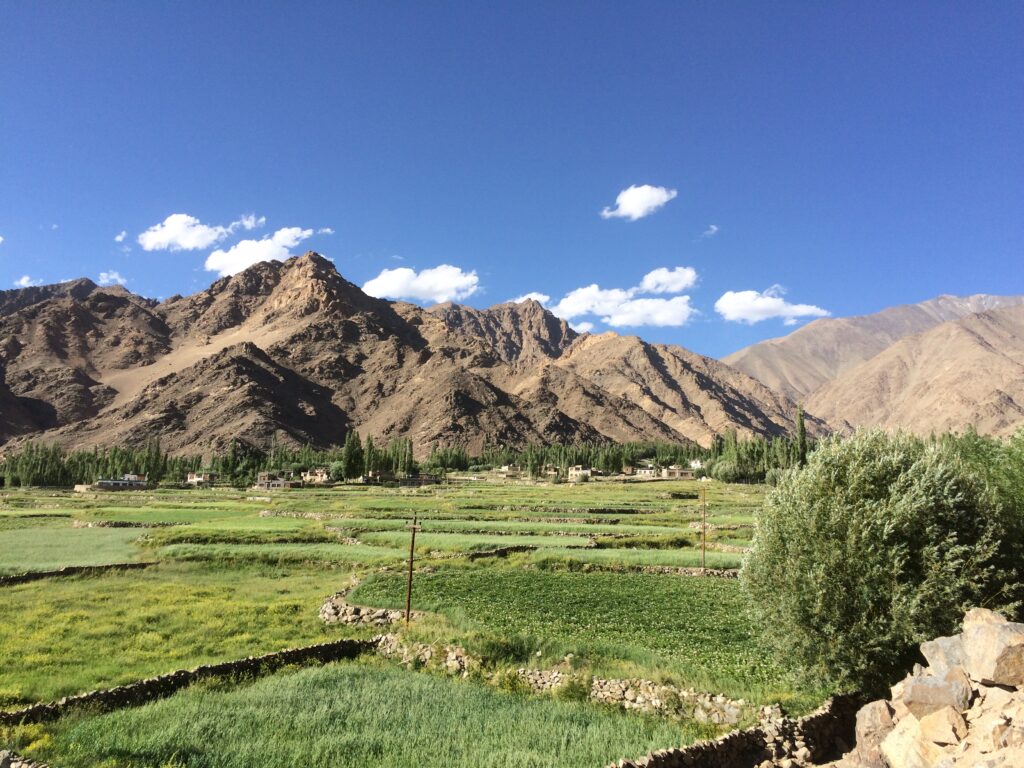
The region has its own microclimate, unconnected with the seasonal weather patterns seen elsewhere in India. Most of the Ladakh Plateau is above 3000m/9842ft, and the mountains that cut it off from the rest of India are over 5000m/16404 high, creating a rain shadow. As a result, the monsoon rains rarely reach Ladakh, and its mountains are almost entirely barren. However, the Indus River, which rises in Tibet, and several of its tributaries, run through Ladakh, making agriculture and human settlement possible between an altitude range of approximately 2000m/6561ft.
Ladakh feels like nowhere else in India, and ethnically and culturally is closer to Tibet and Central Asia, than to the plains of India, Kashmir or the Indian Himalayas. It is sometimes referred to as ‘Little Tibet’ or ‘Western Tibet’, and the Ladakhi language is closely related to Tibetan. The versions of Buddhism followed in Ladakh are very similar to Tibetan Buddhism, and the Tibetan spiritual and political leader the Dalai Lama is widely revered. However, unlike Tibet, being at the crossroads of major trading routes between the Indian plains, Kashmir, Central Asia and Tibet, Ladakh has always had strong connections with the outside world. These interactions over the centuries have changed, enhanced and enriched the region’s cultural heritage. Perhaps these interactions are also what have rendered Ladkahi people so incredibly hospitable and charming.
Over the course of this 13-day trip we experience a great deal of what Ladakh has to offer: from deep gorges to glaciated peaks and snow-capped mountains, from wide oasis-like green valleys to narrow, high mountain passes, extraordinary geological formations, alpine meadows, arid plateaux, sand dunes and deserts, magnificent lakes, wild rivers and bubbling streams, terraced fields, and innumerable monasteries, fortresses and picturesque villages.
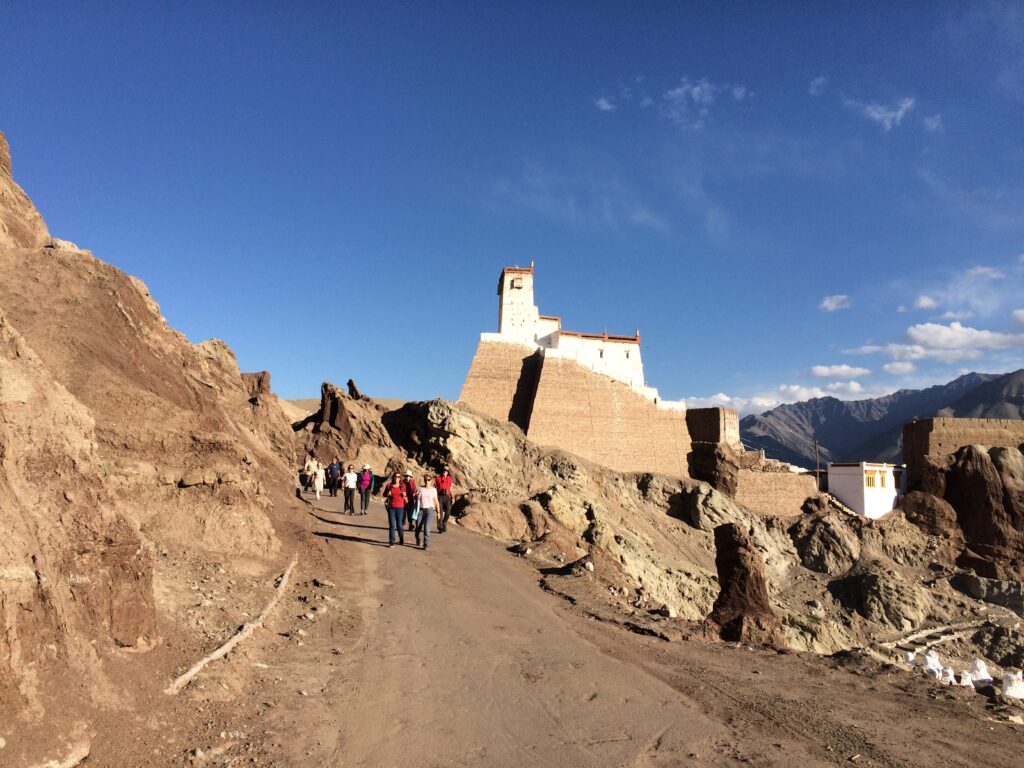
We start the trip at Delhi airport and take a spectacular flight to Leh, where we spend the first three nights in a lovely rural setting in a family owned ‘resort’, with independent cottage-like accommodation. We take the first couple of days very easy in order to acclimatise, limiting our activities to a cooking demonstration, gentle walks and a tour of a historic palace, all with the aim of gaining insight into the Ladakhi culture. We walk over a low ridge to Leh (the buzzing little capital city of Ladakh) and visit an impressive hilltop stronghold and marketplace.
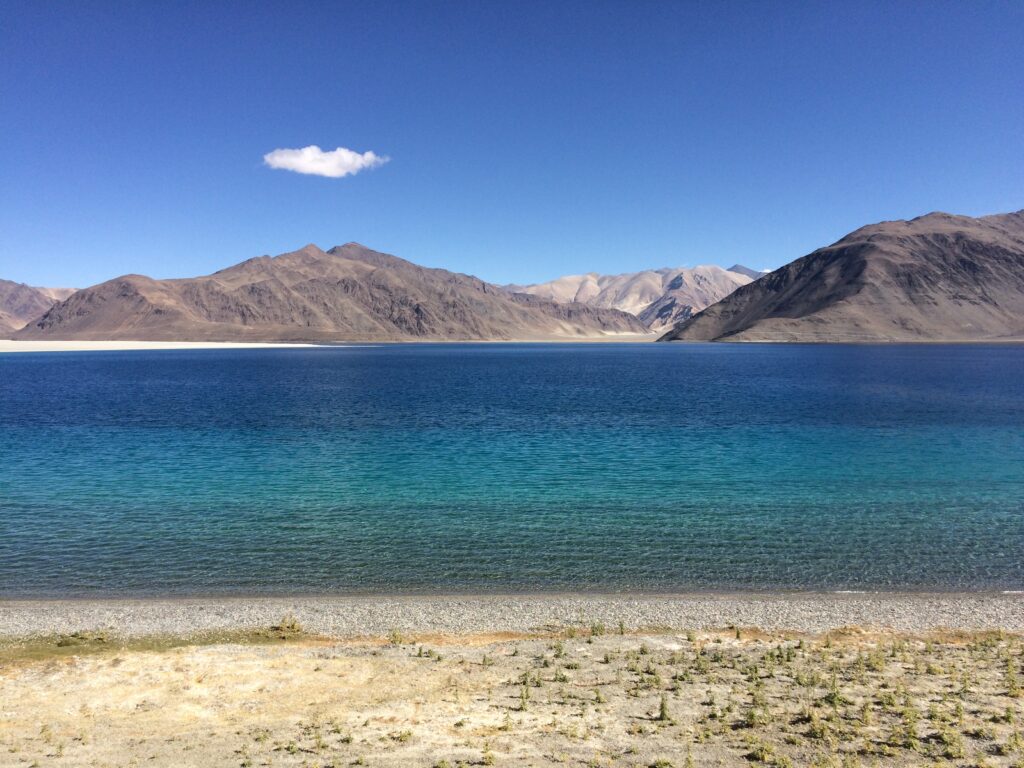
We then leave the upper Indus River valley, stopping for an early prayer ceremony in Ladakh’s largest monastery, before carrying on to the extraordinarily beautiful (high altitude) Pangong Tso lake, over half of which lies in western Tibet, and is seemingly just about as far as one could be from anywhere.
After one night here, we drive over a high and seldom used mountain pass to the Nubra Valley, which is hemmed in on one side by the majestic Karakoram Range, and on the other, the Ladakh Range. Nubra occupies the northeastern portion of Ladakh, bordering Baltistan (in Pakistan), the Chinese Turkestan in the north, and the Aksai Chin plateau and Tibet to the east. The scenery here is truly breathtaking and the valley is considerably lower than Pangong Tso and, on average about 500m/1640ft lower than Leh. We spend 3 nights here near the confluence of the Nubra and Shyok rivers and enjoy a couple of wonderful walks in the vicinity of the Nubra River, amongst sand dunes, alpine pastures and through a splendid Gorge.
After the Nubra Valley, we drive back over the Ladakh Range to Leh via a different mountain pass (one of the world’s highest motorable passes at 5359m/17582ft) and to our hotel for the next 3 nights overlooking the all-so-imporant Indus River. We explore the southern slopes of the Ladakh Range (area known for its surprisingly luxuriant valleys and fruit orchards) and the even more sparsely populated south side of the Indus. Throughout our stay here we also have the opportunity to visit a couple of monasteries and some other very interesting historic sites and delightful villages, one of which is perched high on a spur of rock overlooking an extraordinary lunar landscape.
We return to Leh for our last night in Ladakh and stay in a hotel near the city centre. The following day we fly back to Delhi at around midday and then stay in a hotel near the airport where you have the afternoon to relax and enjoy the rooftop swimming pool. On the last day of the trip when transfer you to the airport and you are free to choose whatever flight suits you best.
For a detailed itinerary and/or further information, please contact us at walkawaytrips@gmail.com
| Fitness Level | 3 | |
| Dates | September 01 – 13, 2026 | |
| Days | 13 | |
| Cost pp. Single S. | €6,750.00 €980.00 | |
| Airport | Delhi |
The fitness level for all trips is classified according to the average distance and elevation gain of the walks offered, with fitness levels ranging from 1-5, see here for more details.